
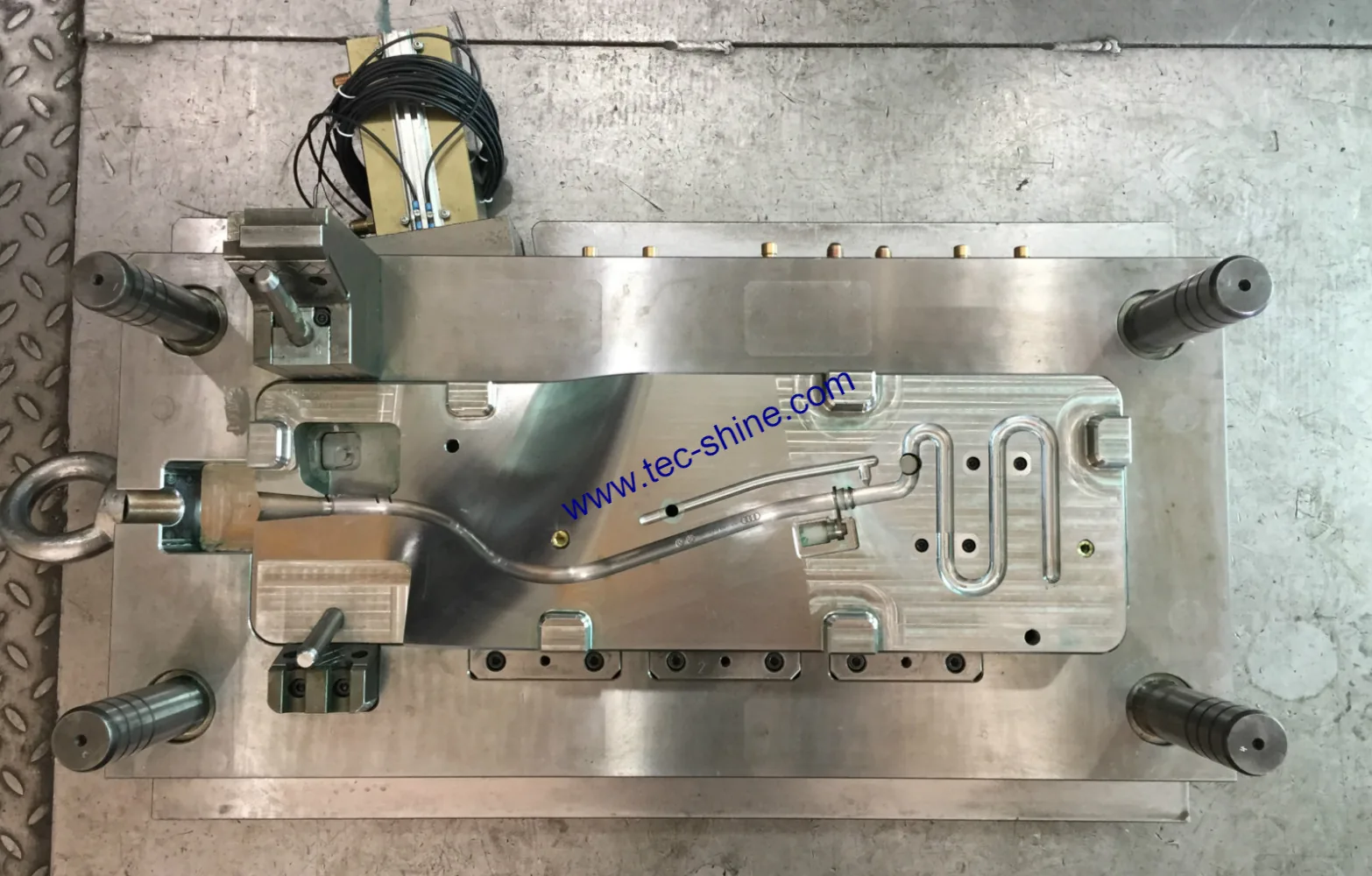
Case study 01 · Automotive · Metal-to-plastic redesign

Automotive Guide Tube: Metal-to-Plastic Redesign with Projectile-Assisted Nitrogen Molding

A former metal guide tube was redesigned as a molded plastic hollow component. The objective was to reduce part cost while retaining the long, curved routing geometry.

Project Summary

Industry
Automotive
Part
Long, curved hollow guide tube
Original design
Metal automotive guide tube
Objective
Reduce cost through plastic molding while keeping the curved routing
Part construction
Plastic only; no metal insert or overmolding
Process
Projectile-assisted nitrogen injection molding
Gate
Single valve gate
Side actions
4 sliders and 1 lifter
Parting line
Follows the tube profile
Outcome
Molded plastic guide tube replaces the former metal design
Shipment
Mold packed in a wooden export crate

The Engineering Problem

The original guide tube was a metal part. The redesign objective was to reduce cost by producing it as a molded plastic part, with no metal insert and no overmolding.

The plastic part still had to follow the same long, curved route, which means a continuous hollow section along a curved path, plus local undercuts that a straight pull cannot release.

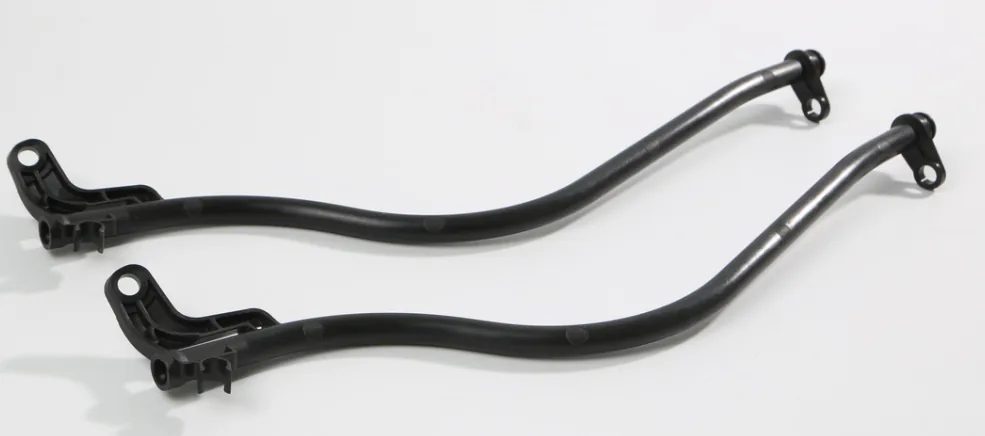
Former metal automotive guide tube selected for redesign as a molded plastic part
The former metal guide tube. The plastic version had to keep its long, curved routing.

Why Projectile-Assisted Nitrogen Molding

The hollow section is formed during molding. Melt is injected through a single valve gate; nitrogen then pushes a projectile through the curved melt path while the polymer is still moldable, leaving a continuous hollow section behind it.

The result is a molded plastic guide tube that replaces the former metal design.

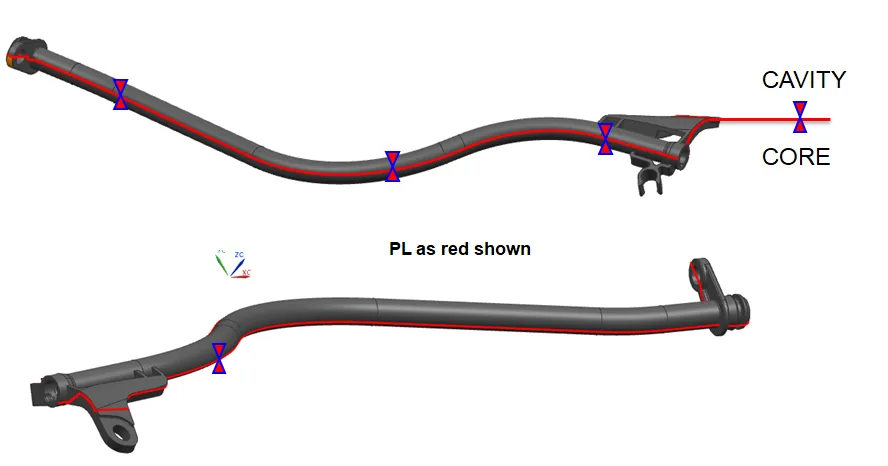
Projectile path and parting-line study for the hollow automotive guide tube
Projectile path and parting-line study for the hollow section.

Release Strategy: 4 Sliders and 1 Lifter

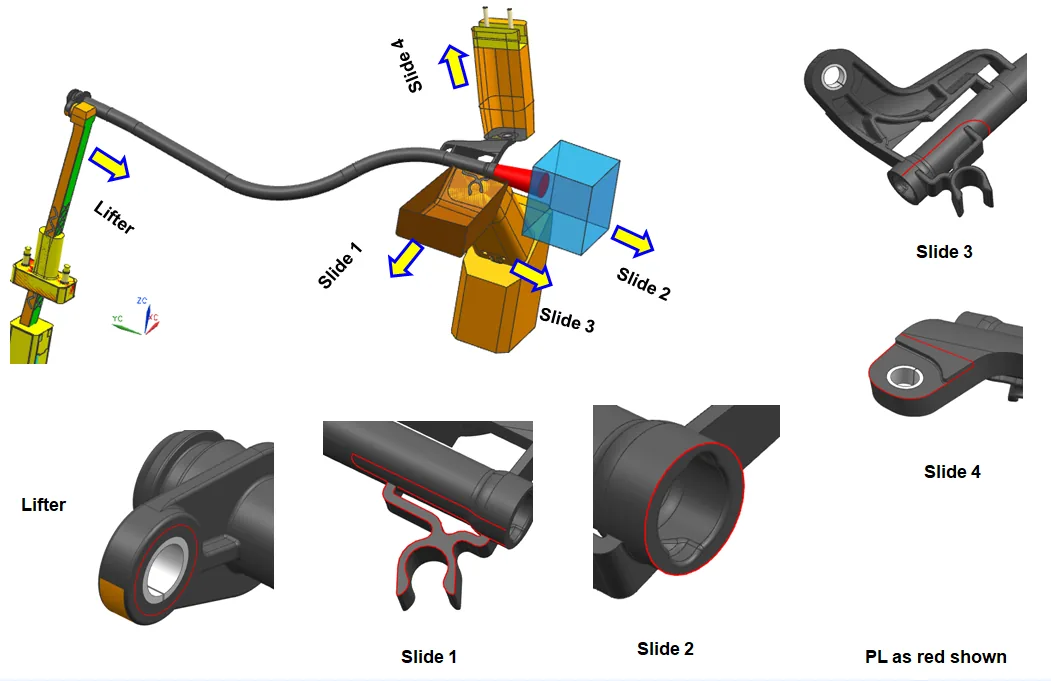
Four sliders and one lifter manage the undercuts. The slide and lifter sequence handles the curved path and the local undercuts.

The parting line follows the tube profile. This controls flash along the tube and supports stable demolding.

Side-action release strategy for the curved automotive guide tube mold
Release strategy: 4 sliders and 1 lifter around the curved tube geometry.

Cavity and Core Construction

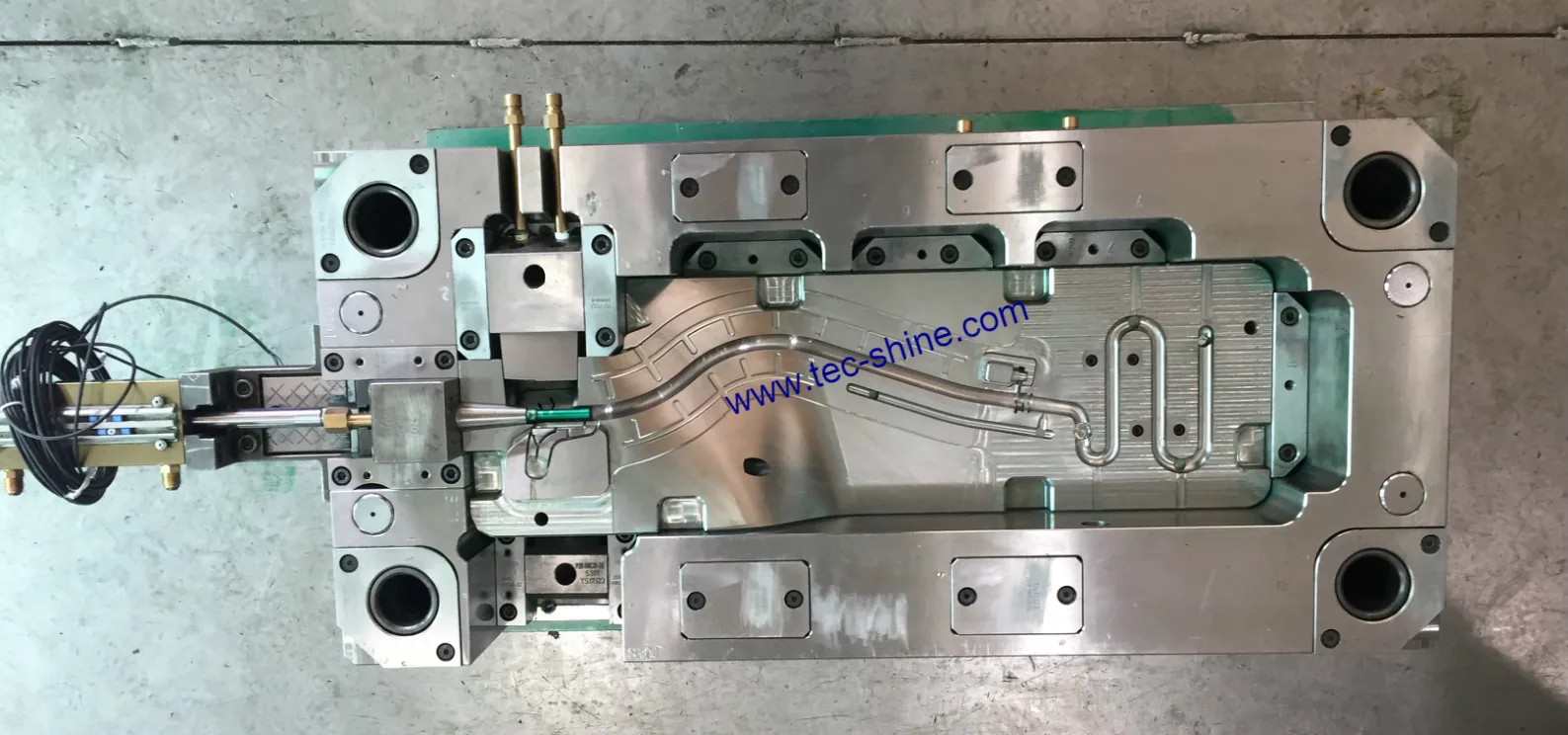
On the cavity side, the long curved cavity integrates the projectile and gas path with the coordinated side actions. The core side carries the matching cavity and the side-action interfaces needed to release the molded tube without a metal insert.

Cavity-side tooling for the curved automotive guide tube
Cavity side: the long curved cavity integrates the projectile and gas path with coordinated side actions.
Core-side tooling for the curved automotive guide tube
Core side: the matching half with the side-action interfaces needed to release the tube without a metal insert.

Export Packing

For international shipment, the mold was wrapped in protective film and secured with internal wooden bracing inside a wooden crate.

Replacing a Metal Part with a Molded One?

Send 3D CAD, material, quantity and timeline. Free initial DFM feedback is sent within 48 hours after complete CAD and project details are received; formal quotation timing is confirmed separately.

Start Free DFM Review